
Volunteer Training Manual
Time Out Youth
Time Out Youth is a grassroots organization founded in 1991 by Tonda Taylor. As a teenager growing up in a conservative, socially prominent family in 1950s’ Charlotte, Tonda knew she was different. Still, like many of the youth we encounter today, she didn’t know why or how to reconcile her identity with society’s expectations. Tonda felt like a stranger in her own hometown. In 1964, Tonda left Charlotte for the more tolerant climate of New York, where she began her career in youth services, working for American Youth Hostels and the Girl Scouts.
Tonda’s self-imposed exile ended 20 years later with an urgent call from home. Her brother, Sam, was dying of leukemia. Tonda returned to Charlotte in 1984 to help her mother and her father, Dr. Andrew Taylor, a prominent Charlotte allergist, care for Sam. Then came the news that through blood transfusions, Sam had contracted HIV, the virus that causes AIDS. Adding to that unthinkable tragedy, Dr. Taylor himself became infected with HIV, either while caring for Sam or possibly from transfusions during an earlier open-heart surgery. At age 80, Dr. Taylor took his own life to spare his family the burden of his illness. Sam died seven months later.
The pain of their deaths, due to what most in the community viewed as a “gay” disease, and the pain she experienced growing up gay in Charlotte were galvanizing influences in Tonda’s life. Shortly after Sam’s death, a friend sought Tonda’s help for a teenager who was struggling with her sexual orientation. Tonda was distressed to learn that no programs or support groups existed in Charlotte for gay, lesbian, and bisexual youth. Soon thereafter, in November 1990, Tonda and a small group of human services professionals, educators, physicians, and clergy met and agreed that these young people desperately needed somewhere to turn for help. A few months later, they formed Time Out Youth. On April 8, 1991, four gay and lesbian youth attended our first weekly discussion group.
Tonda Taylor retired from active service with the agency in the fall of 2004. Since then, Time Out Youth has continued Tonda’s legacy of support, advocacy, and education for LGBTQ youth.
Mission
To support lesbian, gay, bisexual, transgender, queer, and questioning
youth in promoting unconditional acceptance and creating spaces for
self-expression through systematic support, advocacy, social
engagement and leadership development.
Vision
To inspire inclusive communities where all youth are equally
empowered to reach their true potential.
Agency Programs and Services
Time Out Youth provides support, education, and advocacy for gay, lesbian, bisexual, transgender, and questioning youth ages 13 to 24. We have a variety of programs and services designed to empower our youth.
Administrative Hours:
- 10:00 am – 12:00 pm Monday through Friday
- Housing clients can access services and resources.
- 12:00 am – 4:00 pm Monday through Friday
- Youth can access services and resources.
- Clients accessing counseling services may have appointments as late as 6 pm.
- Youth Program Hours:
- Wednesday: 5:30 pm – 6:30 pm for programming
- Mix of in-person and hybrid programs
- Thursday: 5:00 pm-7:30 pm for programming
- Tea Time – Trans Youth Discussion Group
o Every 1st Thursday: 6:00 pm to 7:30 pm
o Every 3rd Thursday: 5:00 pm to 7:30 pm (5 pm-6 pm Drop-In) - Melanin & MagiQ – Queer Youth of Color Discussion Group
o Every 2nd Thursday: 5:00 pm to 7:30 pm (5 pm-6 pm Drop-In)
o Every 4th Thursday: 5:00 pm to 7:30 pm (5 pm-6 pm Drop-In)
- Tea Time – Trans Youth Discussion Group
- Friday: 5:00 pm – 7:30 pm for programming
- 2nd and 4th Fridays are Big Kid Drop-In (17-24 years old)
- Saturday: Drop-In 12 pm – 4 pm
- Wednesday: 5:30 pm – 6:30 pm for programming
- Speakers Bureau
- Host Home Program (Ages 18-24)
- Emergency Financial Assistance
- LGBTQ Resource Library
- College Scholarships
- Special Events (camping & other outdoor activities, socials, lock-ins, etc.)
- Counseling Services
- Gay-Straight Alliance (GSA) Network and School Support
- School & Community Trainings on LGBT-related issues
Working With LGBTQ Youth
Considering Gender
The reality is that sexuality and gender are complex and often misunderstood. Research suggests that sexuality is fluid and most likely influenced by a combination of socio-cultural and biological factors. Sexual identity, behavior, and desire are not always synonymous, but often conflated. For instance, those who engage in same-sex behaviors may not always identify as LGBTQ; a person may not conform to traditional gender roles yet may still identify as heterosexual; and an individual who is transgender may experience same-sex attraction or opposite-sex attraction.
By age three, most children can recognize gender, and by age 5-6, children have a strong understanding of gender-appropriate behavior. Transgender people report experiencing conflict over their gender assignment throughout childhood and adolescence, often reporting that the gender they identify with does not align with the sex they were assigned at birth.
Individuals can become aware of same-sex attraction very early in life, even younger than puberty; they acknowledge or act on it at any point in life. However, since many youth begin to date and have relationships with one another in middle and high school, many LGBTQ teens start to self-identify as such during this time.
- The concept of gender and how it manifests itself in any individual is often a complicated journey, especially for those who wish to transition. A person who identifies as another gender may be undergoing an internal as well as an external transformation towards their personally identified gender.
- If you are unsure of which pronouns to use when addressing a transgender youth, ask them what would be preferred. Make every effort to address the person correctly.
- Be familiar with terminology surrounding gender. See the next page for a gender glossary.
- Most LGBTQ youth do not view gender identity or expression in binary terms; instead, they view these aspects of identity through a spectrum of possibilities.
- When discussing gender identity and expression, remember to think of them as fluid and not either/or. Refer to the Gender Unicorn visual on the next page for additional information.
Remember: It is always okay to ask! It is better to ask a youth how they identify and what that means than to assume you know. This helps youth feel comfortable and accepted for who they are

Respectful Language
Creating an affirming space takes both verbal and nonverbal communication. Using inclusive and respectful language is one of the easiest and most important ways you can support LGBTQ youth.
We must consider all forms of communication, both verbal and nonverbal, to facilitate an inclusive environment. Nonverbal communication includes body language and posture – how do we physically respond when someone discloses? Do we lean in? Do we back away? Speaking practically, the language you use should mirror the language of the person you are serving.
By simply using inclusive language in all your interactions with LGBTQ people, they will feel more comfortable in their environment and know they can come to you for support if needed.
Tips for creating a safe space through respectful language:
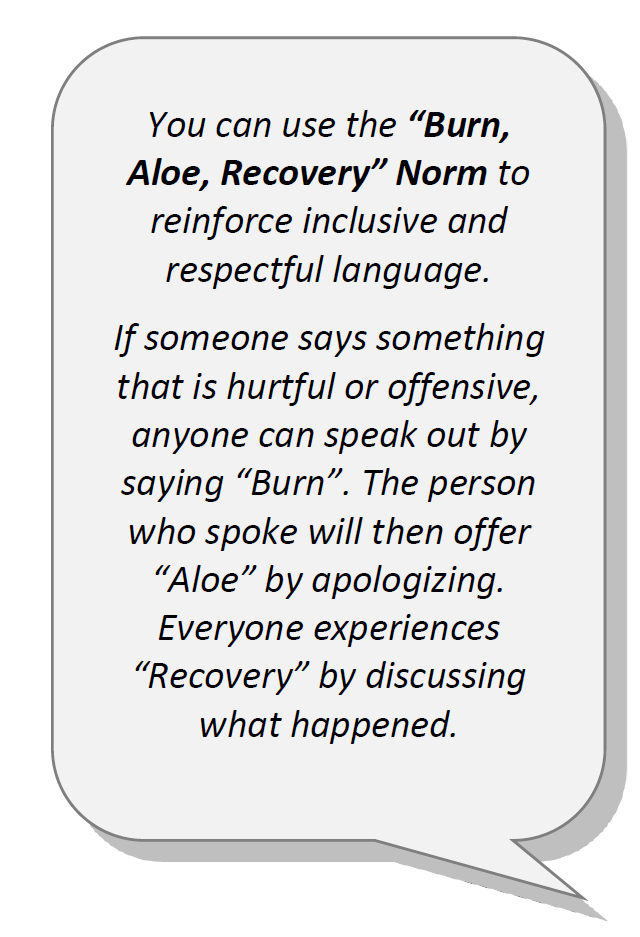
- Be mindful of the language you use when talking with LGBTQ youth. Make sure to adopt the terminology that the youth use to identify themselves.
- It is okay to ask questions if you are unsure of how a youth prefers to be addressed. This is also true for pronoun use, especially for a youth who may be questioning or considering their gender identity.
- Use inclusive language that does not assume any specific sexual orientation, such as “partner” instead of “girlfriend” or “boyfriend.”
- Language does not only refer to spoken language. A facilitator also communicates a lot through body language. Please be aware of what your posture and facial expressions are communicating. These unspoken messages can often have a powerful effect on the group dynamic. Body language can be used positively to convey interest, sympathy, understanding, etc., or negatively to signal a lack of respect, disinterest, or boredom.
Effective ways to respond to offensive language in our space:
We are all human, and sometimes even LGBTQ youth will use language that can be offensive or shaming to their peers. Moments like these are great opportunities to teach inclusive language practices and to reinforce a safe environment. When you hear a youth use language that could be offensive, here are some suggestions for how to create a teachable moment. - It is always essential to make sure that (1) A person feels that they are heard and (2) that they are gently given new language and reasons for the use of that language.
- Discovering the intent behind the words can also help to understand if someone meant something the way you heard it. Asking something like, “I heard you say [word or language]; could you elaborate on that for me?” or “I heard you use [word or language]; what does that mean to you?” can help get at the meaning behind what they said.
Volunteer Guiding Principles
1) Disconnect to Connect – Your primary role as a volunteer is to connect and support our youth. While in the group room and during group night activities, please be mindful of cell phones and other electronic devices while volunteering.
2) Engage – Ask what the youth are doing, learn more about them, and tell them about yourself. Focus on the youth and not the other adults in the room
3) Participate – All of our activities are open to you, too. If youth see you excited about the activity, they will be excited too.
4) Listen Actively – When spending time with youth, listen to what is said and what is not said. Realize that both are important. Sometimes what’s not said is just as important as what is said. Don’t be afraid to ask follow-up questions and always notify staff if you feel a youth needs additional support.
5) Let the Youth Lead – When interacting, always start with ‘what do you want to do?’ ‘What is your opinion about this?’ Empower youth to have ownership over their space.
6) Respect Identities – When speaking, generally avoid gendered language. If you are not sure about a youth’s name and pronouns, always ask, don’t assume.
7) Form & Respect Boundaries – Remember your role as a volunteer within the Center and develop relationships with youth that are healthy and appropriate for the setting. Do not share more of yourself than you are comfortable doing, and respect youth if they are not comfortable sharing or engaging with you beyond their comfort level.
8) Be Dependable – Volunteers are the heart and soul of drop-in and group nights. The more often you come, the better relationships you will have with the youth
9) Maintain Center Culture – Volunteers are to be respected like staff and have staff authority in terms of enforcing policy. Don’t be afraid to correct youth actions and keep our space safe (and PG-13) for everyone.
10) Lean on Staff – We are a team, and you are never alone as a volunteer in our space. If you see or hear something and are unsure how to react, contact staff.
Front Desk Volunteer
Reports to: Operations Coordinator
Purpose: To assist the Center with day-to-day operational needs during Drop-In Hours, managing youth attendance tracking, answering phone calls, and handling inquiries about Center activities.
Hours:
Shifts for this position are available throughout the week. Monday through Friday: 10 am-2 pm, 2 pm-5 pm, OR 10 am – 4 pm shifts
•Wednesday – Friday: Additional shifts available from 5 pm-7:30 pm
Saturday: 11:30 am – 2 pm and 2 pm-4:30 pm shifts
Job Description:
•Welcome youth as they enter the Center, connect new youth with staff or volunteers for tours, and answer questions about the Center as guests come in.
•Notify youth of upcoming special events, programs, or activities as they arrive in the Center.
•Ensure that all youth sign in when they arrive at the Center and sign out upon departure.
•Assist staff with administrative tasks while monitoring the Center’s Lobby.
•Assist staff with answering phones and transferring callers to appropriate staff
Greeting Guests
We want everyone to feel welcome when they come into the Center! Be sure to greet everyone warmly as they come in! Some people you may already know, and some people may be coming in for the first time. Regardless of whether this is someone’s first visit, we want EVERYONE to be greeted!
Things to keep in mind
•Some people may be more vocal or shyer than others, and that’s okay! Just do your best to be friendly and polite. Don’t take it personally if someone doesn’t respond at the same level as you communicate.
•Be sure to mention your name and pronouns when you introduce yourself to a new guest!
-Some people might not know what you mean by ‘pronouns,’ so be ready to explain pronouns and why they are essential in our space.
-Use the pronoun guide in the hallway if a guest needs more of an explanation.
For Adults
•Greet guests as they arrive
•Find out their purpose for visiting
•If visiting a Staff member or Community Office Member, ask the guest to have a seat and reach out to the person they are visiting via their extension
•If they are here to pick up a youth, find out the Youth’s last name and ask the guest to have a seat while you find the youth. Do Not Allow adults to enter the Youth Space. Once the adult is seated, find the youth using their last name. Reach out to staff to help locate the youth.
•If they are a new visitor to the space and want a tour, ask them to have a seat and notify staff.
For Youth
First! Make sure the scanner is running. The scanner software should be up and running at all times. Automatic Scanning should be enabled.
If a youth HAS NOT been to Time Out Youth Center before:
- Have them sign in using the iPad
- Ask them to wait in the lobby and find a staff person to provide a tour
- Staff will take it over from here!
If a youth HAS come to the Center before:
- Have them use their ID Card to scan in
- Look at the screen to see if a message pops up for the youth
- If there is a message, please relay it to the youth
NO ID CARD?
- Click on the People Tab on the Scanner Software
- Ask the youth their last name and search their last name in the People tab
- If there are multiple youth with the same last name, ask the youth to identify their name on the list
- Once you have found the youth in the Person Manager, click the Check mark to the right of their name
- Click Record Attendance
IF A YOUNG PERSON DOESN’T APPEAR IN THE PERSON MANAGER
- Confirm that they have visited the Center before
- Have them sign in on the iPad as if they are new
- Ask the youth to notify a staff person or intern that they need to create a profile in the database
Drop In Space Volunteer
Reports to: Programs Manager or Intake Specialist
Purpose: To provide the benefits of support and experience to our youth through monitoring the Drop-In space.
Hours: Shifts for this position are available throughout the week.
- Thursday: Shifts available from 5 pm-6 pm on the 3rd and 4th Thursdays
- 3rd Thursday Tea Time Drop-In: Volunteers must identify as trans, non-binary, or something other than cisgender
- 4th Thursday Melanin & MagiQ Drop-In: Volunteers must be people of color
- Friday: Shifts available from 5 pm-7:30 pm
- Saturday: Shifts available from 12 pm-4 pm
Job Description
- Welcome new youth by introducing yourself, introducing them to other youth, and making them feel welcome in the space.
- Build rapport with youth by engaging them in conversation and expressing interest in their lives.
- Ensure that all youth feel valued and heard during Drop-In Space.
- Ensure group room rules are being followed during Drop-In Space hours.
- Ensure that all youth are behaving appropriately during Drop-In hours; this includes making sure that all movies, television, music, video games, and discussions are PG-13 or appropriate for all youth between the ages of 13 and 24
- Monitor public displays of affection between youth to ensure they remain appropriate.
- Assist staff with administrative tasks while monitoring the Drop-In Space.
- HAVE FUN!!!
Drop-In Space Guidelines
During Drop-In Space, youth are free to interact with one another or use the services available at Time Out Youth as they wish. Possible Safe Space activities available to youth include:
- Using the computer lab
- Watching TV
- Playing games
- Listening to music
- Working on homework
- Having snacks
- Socializing with one another
- Talking with volunteers or staff
While in general the youth are free to use this time to express themselves and to interact with one another, here are some guidelines we follow to make sure that Drop-In Space remains a safe environment for everyone:
- TV Guidelines: Programs watched during Safe Space must be rated PG-13, TV-14, or lower to be appropriate for the space (no R-rated movies or MA-rated television shows without staff approval).
- Internet Guidelines: Youth can utilize the computer lab for personal, school, or professional purposes; however,
- Adult/pornographic websites are not permitted to be accessed within Time Out Youth
- Adult chat rooms or video chat websites are not permitted
- Dating/personals sites are not permitted
- TV Guidelines also apply to videos streamed on computer
- Public Displays of Affection (PDA): Time Out Youth is like a family, and we encourage our youth to support and to love one another as a family. Because of this, determining an appropriate level of PDA can be difficult. While we want our youth to feel comfortable being able to express themselves, we also do not encourage romantic or sexual relationships to blossom in our space.
- No sitting on laps.
- No two youth should be lying down side-by-side (spooning, cuddling, etc.)
- No youth should be under blankets together lying down
- Heavy petting, kissing, and sexual dancing (grinding) are also not allowed
- Language: Any language that could be received as hurtful or offensive should be called out by volunteers, staff, and other youth. Youth should be encouraged to find alternative ways to express their emotions rather than resorting to expletives or hurtful speech.
Go with your gut! It can be challenging to decide what is and is not appropriate behavior, sometimes depending on the context. If it feels inappropriate to you, it most likely is not appropriate behavior for this space. When in doubt, always ask a staff person for assistance!
Policy & Procedures
Boundaries
Boundaries can be difficult to figure out, especially when working with LGBTQ youth in an environment like Time Out Youth. Our space feels like home to our young people, which can make the dynamics between youth and volunteers hard to navigate. It is natural to want to be part of our youth’s lives and be a resource for them, but without proper boundaries, it can easily become exhausting for volunteers or confusing for youth.
Establishing and maintaining professional volunteer/youth boundaries serves two significant purposes:
- Assurance for volunteers that they will maintain professional and ethical standards.
- Assurance that youth will maintain clarity in their relationships with volunteers.
Maintaining professional boundaries is the responsibility of staff and volunteers. This includes facilitating appropriate boundaries between youth. Examples of boundaries include:
- Communication:
- Inappropriate comments about a youth’s appearance, including excessive flattering comments.
- Inappropriate comments about a youth’s cultural, ethnic, racial, religious, socioeconomic backgrounds, etc.
- Jokes or innuendo of a sexual nature.
- Facilitating access to overtly sexual material.
- Failing to stop sexual harassment between youth.
- Failing to stop or engaging in discriminatory or otherwise offensive conversation.
- Physical Contact:
- Unnecessary, unwanted and/or inappropriate touching of a youth.
- Initiating or permitting inappropriate physical contact by a youth (e.g., tickling games, snuggling).
- Allowing youth to engage in any inappropriate physical contact while at Time Out Youth.
- Involvement:
- Inviting or encouraging youth to come to your house (without Center approval).
- Being alone with youth outside of a Time Out Youth event (without Center approval).
- Adopting a welfare role that is the responsibility of another staff member, or doing so without the knowledge of the staff. (e.g., giving money, buying food, gift certificates, etc.)
- Always use the Volunteer/Youth Contact Form for any important conversations or interactions with youth, so staff are always aware.
Two important things to remember about boundaries:
When in doubt, ask a Time Out Youth staff member
Go with your gut. If it feels inappropriate, it probably is.
Common Scenarios
Below are some specific scenarios that volunteers frequently bring to our attention as areas where it can be challenging to determine boundaries. Use these guidelines to determine best practices when you encounter a boundary issue.
- Internet/Social Media
- Do not add a youth to a social media site like Facebook. Your role as a volunteer could make a youth feel obligated to add you back. Instead, wait for a youth to send you a request to connect online.
- Do not feel obligated to accept connections from youth online if they do send a request. You have a right to your space. Determine what level of connectedness feels comfortable for you.
- If you do decide to add a youth, we ask that you filter any content that would not be appropriate (think PG-13) for them to see.
- If a youth reaches out to you for help on a serious issue such as self-harm, depression or abuse, make sure that you encourage the youth to check in with a staff person at Time Out Youth and be sure to notify a staff person of this contact.
- See the Suicide Protocol for more details on how to discuss suicide.
- Never tag a photo of a youth online, even if the photo is not at Time Out Youth.
- Phone
- Do not request that a youth give you their phone number.
- If a youth asks you for your phone number, you have the right to decide whether to provide it.
- Notify a staff member that a youth has your contact information.
- As with social media sites, please notify staff immediately if a youth contacts you over a serious issue (depression, abuse, self-harm, etc.)
- If you feel the need to check in with a youth by phone, make sure you have already discussed with the youth about any privacy issues:
- Can you leave a voicemail? Does anyone else check or use this phone
- Contact Outside of Time Out Youth
- Do not approach a youth if you see them in public, instead wait for them to engage you.
- Do not reveal any information when talking to a youth that might “out” them to anyone else that they are with.
- Money
- Do not provide youth with money.
- If a youth approaches you for financial help for any reason, please refer them to staff.
- Time Out Youth provides Emergency Financial Assistance to our youth in need.
Grievance Policy
Time Out Youth seeks to maintain a high level of employee and volunteer morale by promoting a climate that maintains satisfactory working conditions for all employees and volunteers.
It is the policy of the Time Out Youth to provide for the settlement of problems and differences through an orderly grievance procedure. Grievances should be settled informally, if possible. Every non-probationary employee and all volunteers shall have the opportunity to present a problem or grievance in accordance with the procedures prescribed, free from interference, coercion, restraint, discrimination, or reprisal. All documents, communications, and records related to the processing of a grievance will be kept in the personnel file of any participant.
Time Out Youth recognizes that employees and volunteers may occasionally experience dissatisfaction or misunderstandings. Time Out Youth encourages a quick and reasonable resolution of any such problems or complaints. The following steps are suggested guidelines for employees or volunteers to ensure that concerns or complaints are handled most effectively.
The following procedures will be used for the orderly resolution of problems that may arise:
- Informal – An employee or volunteer with a reasonable grievance should first meet with their immediate supervisor to resolve the issue.
- Formal – If the matter is not resolved to the satisfaction of the aggrieved party through informal discussion, that party should submit a written grievance to the aggrieved party’s immediate supervisor within 15 calendar days of the event(s). The statement of grievance shall specify the nature and facts giving rise to the grievance and the remedy sought by the aggrieved party.
- Appeals – Should the aggrieved party(s) be dissatisfied with the Executive Director’s decision, then the grievance shall be taken to the Chair of the Board of Time Out Youth. If the grievance is with the Executive Director, the written grievance should be sent directly to the Chair of the Board of Directors. Appeals will receive a response within 5 calendar days.
- The Executive Director or Chair of the Board will provide the aggrieved party(s) with a written statement which shall specify their understanding of the matter, along with a rationale and a decision.
- Should dissatisfaction with the Executive Director or Chair’s decision exist, then the grievance shall be taken to the Executive Committee of the Time Out Youth’s Board of Directors within 5 calendar days. Final determination shall be the action of the Executive Committee.
Health and Safety Policies
Safety
The safety of our youth is crucial. Safety concerns will override confidentiality in any situation that may result in physical or emotional damage to an individual or the group. Adult staff and volunteers will be briefed on conditions that may pose a risk, as well as the steps to take should such a situation require their intervention or action.
Violence, or threats of violence, will not be tolerated among youth, staff, or volunteers and will be grounds for immediate expulsion from Time Out Youth activities.
Weapons
Time Out Youth maintains a safe environment for all individuals. The Center prohibits the possession of firearms and weapons regardless of any license or permit.
Drugs and Alcohol
Drugs and alcohol do not have a place in any Time Out Youth activities. Staff and volunteers will be expected to abstain from consuming alcohol when participating in Time Out Youth. Staff and volunteers will not supply alcohol or drugs of any kind to youth, including those of majority age. If a youth is found using or under the influence of drugs or alcohol at a Time Out Youth activity, volunteers should report information to staff as soon as possible. If a youth is found to be under the influence, they will be isolated from other youth, and a staff person will be contacted to discuss the situation with the youth. Youth who engage in such behavior repeatedly will be asked to discontinue their involvement with Time Out Youth.
Smoking
Time Out Youth Center always maintains a smoke and tobacco-free environment in its facilities. Staff, volunteers, and youth shall not smoke on Time Out Youth property or near the Center.
Emergency Procedures
Accidents and safety concerns
Employees should immediately report all accidents, whether apparent injury results, to the Director of Youth Programs or the Executive Director. Employees have a duty to report unsafe working conditions to their supervisor or the Executive Director.
Medical
In the event of a minor injury to staff, youth, or visitors (e.g., cuts, scrapes, bruises, twisted ankles), Time Out Youth staff may administer basic first aid. The First Aid kit is in the kitchen.
In the event of a more serious injury, staff must contact 911 and arrange for the individual to be transported to the hospital. In the event of such an emergency, a Time Out Youth staff member must accompany the individual to the hospital in the ambulance.
As part of the intake process for youth who attend Time Out Youth, youth under the age of 18 must provide the name and emergency contact number of a parent or guardian; and youth 18 or older are strongly encouraged to provide the name and emergency contact number of a parent, guardian, or other designated person to be contacted in case of emergency. Staff must notify the parent or guardian of an injured youth under 18 who is transported to the hospital. For an injured youth aged 18 or older being transported to a hospital, staff should ask the youth for permission to contact the designated person. The Executive Director or designee will attempt to contact the emergency contact on file in the employee’s personnel folder.
Incident Reports
All such incidents must be immediately reported to the Director of Youth Programs or the Executive Director. A written Incident Report must be completed by the staff member who was most involved as soon as possible after the situation is resolved; signed and dated by the staff member and Executive Director before being placed in the appropriate file.
If a Time Out Youth staff member detects smoke or fire or the fire alarm sounds, they must contact 911 and notify staff. All staff, volunteers, and youth must leave the building immediately. In this instance, all staff should walk to a safe location near the buildings to answer questions from arriving fire officials.
Emergency Preparedness Plan
Emergencies may involve threats to public health, weather-related disasters, or terrorist acts that involve explosives, radiological, biological, or chemical releases. Different types of events may require unique actions.
Please follow the information below as general guidelines in case of such situations. If Time Out Youth must be evacuated, an authorized staff member will announce on the intercom system. If a volunteer believes there is an imminent and credible threat and cannot locate an authorized member of staff, they are authorized to announce an emergency evacuation. Imminent and credible threats involve those that are reported on the television or radio in the instance of a state of emergency or any other emergency. After the announcement, all staff members must calmly walk to the nearest exit and onto the primary assembly site (detailed below). In all public spaces, there are maps of the building with the closest exit route. The lead staff will check each room of the building to ensure no one has been left behind, then lock the doors and set the alarm as they go.
The designated staff will be responsible for contacting the appropriate authorities. If relocation to the secondary assembly site is needed and there is no imminent danger posed by remaining at the primary site, the lead staff member will stay at the primary site and redirect staff to the secondary site.
Primary Assembly Site: Front parking lot of the Center, or the field in the back of the Center.
3800 Monroe Road Charlotte, NC 28205
Youth Transportation Policy
Time Out Youth Transportation volunteers/staff may be asked to provide transportation for clients to Time Out Youth-sponsored events.
Volunteer/Staff Transportation Providers Requirements:
•Complete a volunteer application or be employed by the agency
•Complete a Time Out Youth Center volunteer orientation
•Provide copies of a valid driver’s license, registration form, and proof of insurance coverage (License, registration, and insurance will be verified once per year)
•Meet minimum driver standards reviewed through a Motor Vehicle Report
•Notify the Director of Youth Programs or Executive Director of any traffic citations received -even if given while driving on their personal time.
Minimum driver standards:
1. Minimum of 25 years old.
2. Have a valid driver’s license for a minimum of three years.
3. Properly licensed and insured.
3. Be considered safe and reliable.
4. Must not have more than one chargeable accident in the past five years.
5. Must not have a DWI conviction in the past ten years.
6. Must not have more than three driver’s license points at one time.
Youth to Adult Ratio
Three people per car (one staff, two youth; two staff, one youth; one staff, one volunteer, one youth; two adult volunteers, one youth, etc.)
Process:
A client utilizing the volunteer transportation will sign a parent/guardian release form; if over 18 years old, the client will sign a release form. The client must have a signed permission slip releasing the Center and the volunteer from liability (to be maintained in the client’s file for 1 year).
Emergencies:
In the event of an emergency during transport, the driver is to pull over and call 911 for assistance. The volunteer is to report any emergencies or other problems to the Center staff
Volunteer/Staff transporters will not:
1. Make sexually explicit comments, or solicit sexual favors, or engage in sexual activity
2. Solicit or accept controlled substances, alcohol, or medications from riders
3. Solicit or accept money from riders
4. Use alcohol, narcotics, or controlled substances, or be under their influence, while on duty
Youth Interaction Policy
Time Out Youth Center recognizes the inherent power imbalance between youth and adults and the need to exercise extreme care to avoid taking advantage of this imbalance in delivering services. The following guidelines for relationships among employees, interns, volunteers, and Center youth are intended to assist the Center and its employees/interns/volunteers in maintaining a high standard of professionalism and leadership responsibility. A youth is a young person under 25 who has received services at Time Out Youth Center.
Employee/intern/volunteer interactions with Center youth outside formally scheduled Center activities should be limited to unplanned contacts in public places. In addition, the following standards must be followed:
Employees/interns/volunteers will not share in or encourage the use of alcohol or illegal drugs by any Center youth.
Employees/interns/volunteers will not make a habit of seeing or talking to Center youth outside the context of Center activities.
Phone calls to/from youth, e-mail contact, and any one-on-one meetings with youth are beyond the accepted employee/intern/volunteer role. Contact with individual Center youth after hours for social, recreational, personal, or counseling purposes is strictly prohibited.
Employees/interns/volunteers are responsible for assuring that interactions with Center youth are nonsexual and that no messages are given to Center youth that imply a sexual interest. Any contact involving or suggesting the establishment of intimate and/or sexual relations between employees/interns/volunteers and Center youth, or between employees/interns/volunteers and members of a Center youth’s family, is strictly prohibited.
Center employees, interns, and volunteers are expected to refrain from sexual activity with anyone under age 18. Planned social activities outside Center facilities must receive prior approval from the Executive Director and should be offered openly to all Center youth. Employees, interns, and volunteers who are approached by Center youth seeking to establish a relationship or obtain services beyond those provided by employees (e.g., being asked for a home or office phone number or address, a place to stay, or counseling services) should inform the youth of the prohibitions on adult-youth interactions and refer the youth to Center staff for additional services. Employees, interns, and volunteers should notify the Executive Director of any pre-existing relationship with a Center youth or potential Center youth under age 25. Violation of any of the above policies is grounds for the immediate termination as a Center employee/intern/volunteer.
Confidentiality Policy
Purpose
Our clients, volunteers, and employees have entrusted their personal information to Time Out Youth. This information contains highly sensitive material and requires thoughtful and attentive management by those who have access to it. Time Out Youth is committed to protecting our employees’, volunteers’, and clients’ right to privacy and safeguarding their protected health information. This policy and other specific related policies are intended to implement a person’s right to privacy concerning their protected health information in accordance with federal and state law.
Policy:
Time Out Youth employees and volunteers may learn highly personal, confidential facts about clients, clients’ families, volunteers, and Time Out Youth staff. Examples of such information include medical conditions and treatments, finances, living arrangements, addresses and phone numbers, employment, sexual orientation, relationships with family members, and even the fact that an individual is a Time Out Youth volunteer or client.
It is understood that all such information must be treated as completely confidential. There should be no disclosure of any information of a personal and confidential nature to any person unless they are affiliated with Time Out Youth and have a professional need to know the information to perform their job.
Except as required by law, staff and volunteers will NOT share information about discussions, activities, behavior, or identities of individual participants with anyone outside of the organization. Staff and volunteers will not share information about individual clients with other youth or staff, except for purposes directly related to programming.
Examples of when we break confidentiality:
•If a youth is injured and requires medical attention
•If a youth is under 18 and reveals that they are being abused or neglected by a parent, guardian, custodian, or caretaker
•If a youth indicates that they want to injure themselves or anyone else
Conflict of Interest Policy
Purpose:
The 1991 NC Sessions Laws, Chapter 689, S 13, requires each private non-profit entity that receives and disburses state funds to have a conflict-of-interest policy for its board of directors, clients, volunteers, and staff. Time Out Youth, Inc. is aware that one of its most important duties is to review the disbursement of public and private monies in support of its direct services to clients and its public education program.
Policy:
Conflict of Interest means a conflict, or the appearance of a conflict, between a person’s private interests and official responsibilities in a position of trust. Persons in a position of trust include staff members, volunteers, officers, and directors of Time Out Youth.
The standard of behavior at Time Out Youth is that all staff, volunteers, and board members scrupulously avoid any conflict of interest between the interests of Time Out Youth and their personal, professional, and business interests. This includes avoiding both actual and perceived conflicts of interest.
The purposes of this policy are to protect the integrity of Time Out Youth’s decision-making process, to enable our constituencies to have confidence in our integrity, and to protect the integrity and reputation of volunteers, staff, and board members.
During meetings or activities, any personal interests in a transaction or decision (including a business or other nonprofit affiliation) must be fully disclosed when a staff member or board member, their family members, and/or a significant other, employer, or close associate will receive a benefit or gain. After disclosure of the potential conflict of interest, an appropriate determination will be made regarding exclusion from discussions and decisions regarding that matter, so that any conflict of interest is avoided.
I understand that this policy is meant not to be a supplement to good judgment, and I will respect its spirit as well as its wording.
Volunteer Dress Policy
The following is a general policy and is to be regarded as the minimum standard throughout Time Out Youth. This policy applies to all agency volunteers.
•Time Out Youth is a casual environment where jeans, appropriate-length shorts, and/or sneakers are permitted. Volunteers should be comfortable while in the space but dressed appropriately.
•Attire should not display or condone illegal or inappropriate behavior, language, or imagery.
•Dresses and skirts must be a professional length.
•Visible tattoos or piercings are permitted but should be appropriate in content. Further action by volunteers to conceal tattoos containing inappropriate content might be required.
•Appropriate personal hygiene habits are to be observed at all times.
•Scented fragrances should be minimal.
Whistleblower Policy
This policy is intended to encourage and enable employees, volunteers, and others to raise serious concerns internally so that Time Out Youth can address and correct inappropriate conduct and actions. It is the responsibility of all employees, volunteers, and board members to report concerns about violations of Time Out Youth’s “Staff and Volunteer Code of Ethics and Policy Guidelines” or suspected violations of law or regulations.
There is a zero-tolerance policy against retaliation against anyone who reports, in good faith, an ethics violation or a suspected violation of the law. An employee who retaliates against someone who has reported a violation in good faith is subject to discipline up to and including termination of employment. A board member who retaliates is subject to removal from the board.
Any suspected violation should be reported immediately to the Executive Director. If you are not comfortable speaking with the Executive Director or if you are not satisfied with the ED’s response, you are encouraged to talk with the Chair or Vice Chair of the Board of Directors. The Executive Director is required to report complaints or concerns about suspected ethical and legal violations to the Board Chair, who will oversee an investigation of all reported complaints.
Reports may be submitted on a confidential basis. Reports of violations or suspected violations will be kept confidential to the extent possible.
Non-Discrimination Policy
It shall be the policy of Time Out Youth to provide equal membership, employment, and service opportunities to all eligible persons without regard to race, religion, color, creed, ancestry, national origin, citizenship, age, gender, sexual orientation, gender identity, marital status, parental status, handicap, membership in any labor organization, political ideology/affiliation, or, for employment only, height, weight, and record of arrest without conviction, disability of an otherwise qualified individual, or any other legally protected basis, to the fullest extent provided by applicable federal, state, and local law.
Staff Support
Time Out Youth could not successfully operate and meet the needs of our youth without the support of volunteers like you. As a volunteer for Time Out Youth, you have a unique opportunity to directly impact the lives and well-being of LGBT youth in our community. We don’t expect you to have all of the answers or know how to address every situation perfectly. Our staff is here to support you throughout your volunteer experience, and we encourage you to keep in touch with us and to express your concerns or questions openly. Time Out Youth staff is available to speak with our volunteers in person, by phone, or by email outside the hours we are open to serving youth. If you would like to schedule one-on-one time to speak with a staff person, let us know, and we will work with you to provide the assistance you need.